The What
Focused on how nonprofit arts organizations, especially founder-driven, mission-based institutions, can manage closure as a planned, governed, and publicly valuable process. Using Exit Art’s closure journey and related academic literature as the core material, distilled structured best practices (process design, resource allocation, stakeholder and narrative management) for boards and leadership teams.
The How
Integration of Theory and Evidence
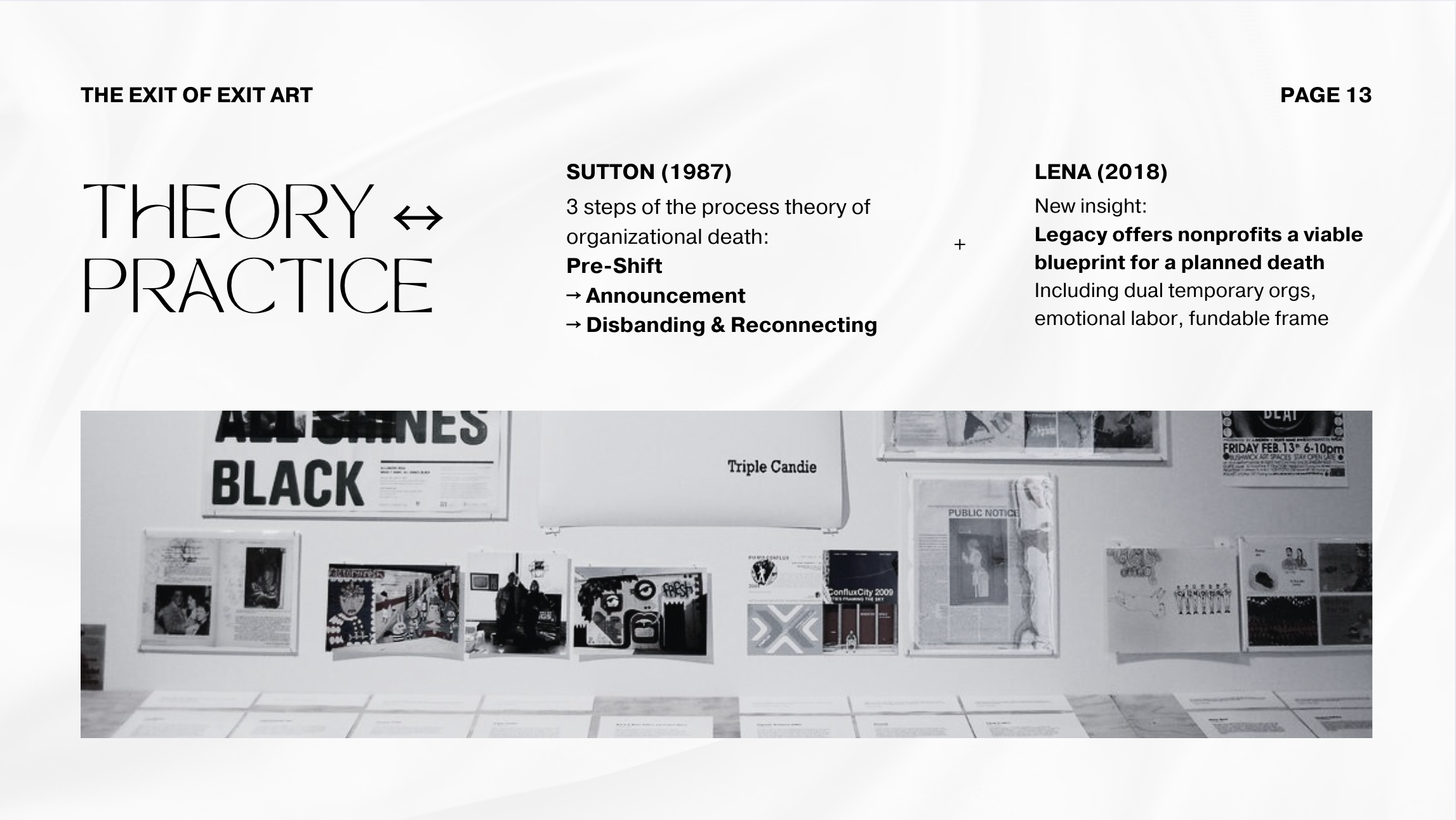
Applied Sutton’s (1987) “Organizational Death Process Model” (pre-shift → announcement → disbanding/reconnecting) as the analytical framework, cross-referencing Lena’s (2018) archival research, interviews, and process documentation of Exit Art to identify governance priorities and risk controls relevant to nonprofit arts institutions.
Mechanistic Breakdown
Treated “disbanding” and “reconnecting” as two parallel, governable workstreams, mapping out critical decision points: announcement timing, order of asset/liability disposition, archival and knowledge transfer, sequencing of public events and publications.
Best Practice Extraction
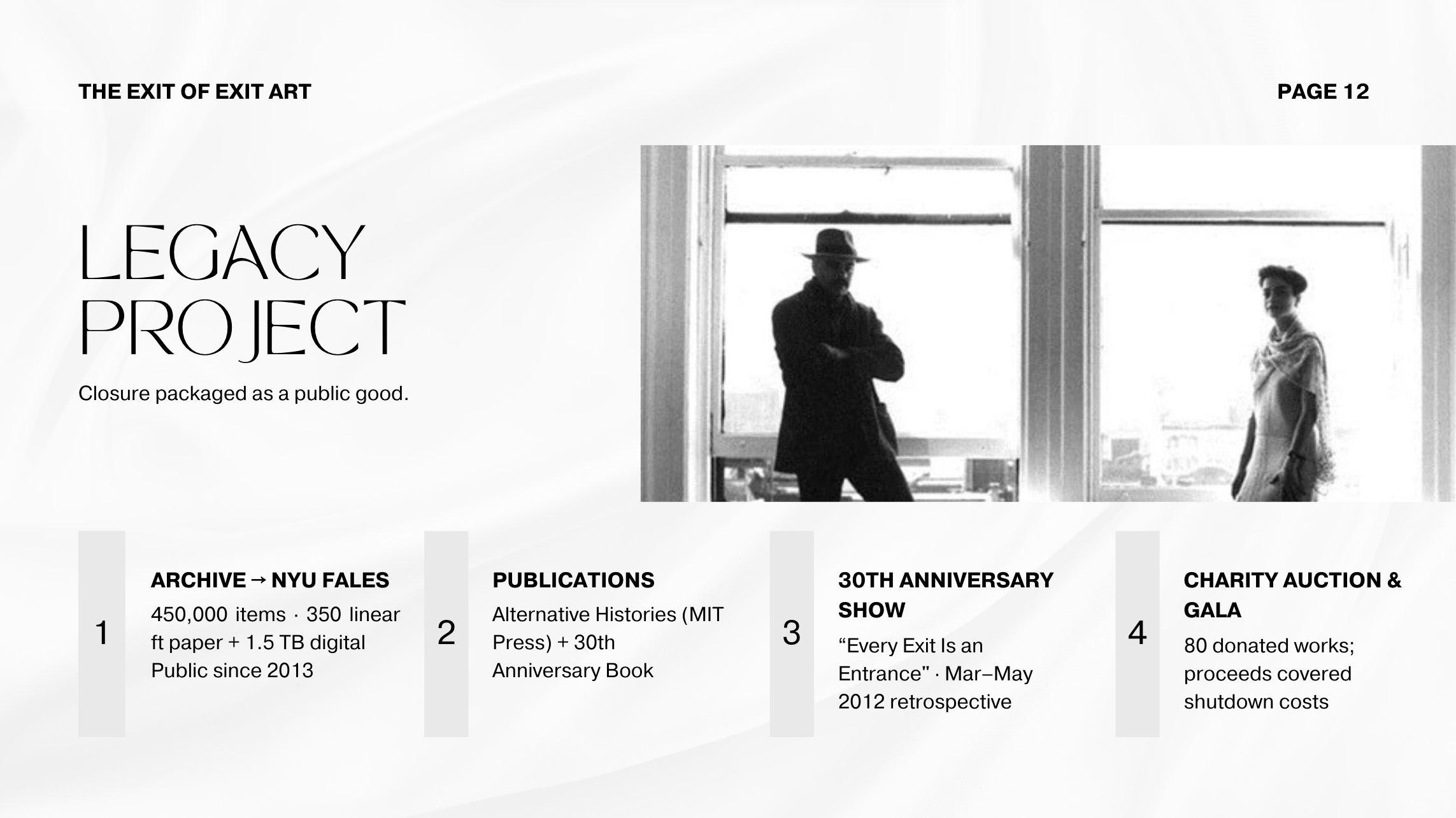
Drew from Exit Art’s Legacy Project as an example of governance innovation—anchoring closure around public benefit and knowledge preservation, and integrating resources through funder-friendly deliverables (archival accession, publication, retrospective exhibition, benefit auction) to transform closure into a fundable mission.
The Insight - Best Practices
Reframe “Closure” as a Governable Mission: Make Legacy the New Mandate
- Define the final year’s OKRs around fundable public outputs such as archival accession, publication, retrospective exhibition, and benefit auction, giving funders, community, and media concrete points of engagement and evaluation.
- This mission-based approach sustains legitimacy, resource mobilization, and team cohesion without pursuing ongoing operations.
Dual-Track Approach: Designing Disbanding × Reconnecting with Sequenced Governance
- Follow a sequencing logic of “people before things, obligations before assets, public commitments before internal allocation” to reduce operational risks; switch to a temporary organization project pace immediately after announcement.
- Redirect assets and relationships into broader public domains (university archives, museum collections, peer networks) to extend brand influence as long-term public goods.
Governance Sensitivities: Founder Dependence, Emotional Labor, and Narrative Strategy
- For founder-dependent organizations, plan succession and closure triggers in advance to prevent governance vacuums caused by single-point failures.
- Formalize emotional support and grievance mechanisms to prevent informal power structures from shaping team dynamics during high-pressure closure phases; adopt a public narrative of “mission accomplished/knowledge transmission” to reduce stigma and increase participation.